Marketing Budget
Calculator
For Projects

Set a budget for your next project, the right way.

Calculator | Hue Marketing

The success or failure of any marketing project is defined by achieving your business goals. The increased revenue is a byproduct of successfully achieving those goals. A common mistake to make when budgeting is to assume that you can maximize your profit by reducing your investment.  This false assumption can lead to underinvesting and a total failure to meet marketing goals.

It is crucial to balance profitability with maximizing the chances of success when creating a project budget. By doing so, you can increase your likelihood of achieving your marketing goals and even surpassing them.

Not sure how to budget for your next marketing project?

Here’s the perfect solution.  Using our dynamic calculator you can experiment with different budget scenarios based on your expected returns and target ROI. The optimal marketing budget is calculated based on your business intelligence to be used as a starting point for your own more accurate calculations.
Need Marketing Budget Help?

If your marketing activity isn’t profitable on paper it won’t work in practice.
We can help crunch the numbers and offer industry insights!

Calculator Help

Disclaimer: The marketing budget calculator is intended to provide a suggested optimal marketing investment for your project.

You should always conduct your own manual calculations for your budget that account for your unique business costs prior to starting any project or activity.

Marketing Project Budget Calculator "About Your Business"

Business Intelligence Section

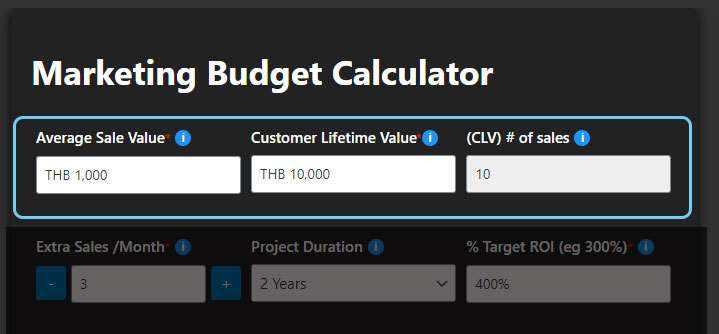
Average Sale Value

To calculate your business’s ASV, you would add up the total value of all transactions during a given period (for example, a day, a week, or a month) and then divide that total by the number of transactions.


Customers Lifetime Value

Customer Lifetime Value is a metric used to determine the total value that a customer brings to your business over the course of their relationship with your company. It takes into account how much the customer is likely to spend, how often they are likely to make purchases, and how long they are likely to remain a customer.

Let’s say that the average customer in a coffee shop spends ฿200 per visit and comes in twice a week, which means they spend ฿400 per week. If the customer is likely to continue visiting the shop for two years, then their CLV would be:

CLV = (฿400 per week x 52 weeks per year x 2 years) = ฿20,800

By understanding your CLV, you can make informed decisions about how much to invest in acquiring new customers and how much to spend on retaining existing ones.


(CLV) # of Sales

This is a simple calculation that divides your Average Sale Value into your Customer Lifetime Value to highlight how many repeat purchases your average customer makes.

  • Repeat customers are 10 times more profitable than first-time buyers.
  • It costs 5 times more to acquire a new customer than to retain an existing one.
  • A 5% increase in customer retention can lead to a 25-95% increase in profits.

If your repeat purchases are low, this could mean that your business is failing to create a positive customer experience or that your products or services are not meeting the needs of your customers. It could also indicate that your marketing and customer retention strategies are not effective, or that your pricing is not competitive with other options in the market.


Marketing Project Budget Calculator "About Your Project"

Project Section

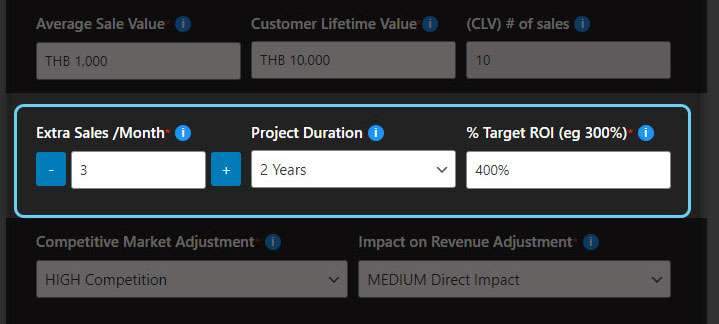
Extra Sales /Month

Enter how many additional sales you estimate the marketing project will help convert. (For simplicity, the calculator assumes that new sales are new customers).

There’s no one more qualified to estimate the effect of a promotion on your business than you. Take into account seasonal differences, previous promotions, and marketing conditions.


Project Duration

Rage 6 months to 3 years.

When considering a budget for a specific marketing activity or project it’s better to consider the length of time it will be actively working for your business in addition to how long it will take to reach your target goals.

Website Examples:

  • Basic Website (6-12 months)
  • Lead Generation Website (12-24 months)
  • Brand Building Website (24-36 months)
  • eCommerce Website Package (12-24 months)

% Target ROI

ROI is not actually a measure of profitability but how efficiently you achieve your goals. While 500% ROI is often quoted as an excellent marketing return, this is an average across all industries and is reliant on getting many aspects of your business just right.

Your actual Marketing ROI will depend on your industry, type of project, profit margins, competition, project goals, and how efficient your marketing foundation is as a whole.

Base your ROI Targets on past experience, not wishful thinking.
Targeting an overly ambitious ROI will decrease your investment which can decrease the effectiveness of your project.


Marketing Project Budget Calculator "Real World Adjustments"

Adjustments Section

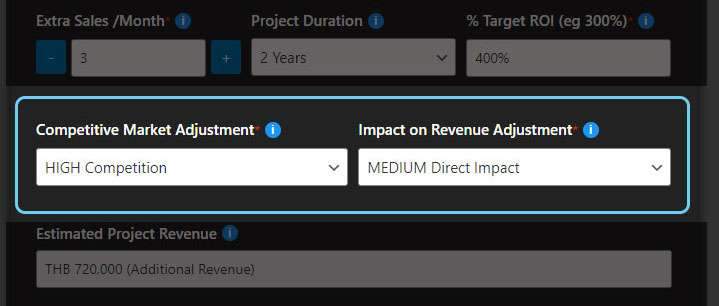
Competitive Market Adjustment

This helps you fine-tune your budget based on how much competition there is in your industry and area. It’s based on the principle that it is harder to make an impact in a saturated market and therefore you should expect higher costs.

LOW – MEDIUM – HIGH

You can see the direct effects of this selection in the Optimal Marketing Budget total and also % of Revenue.


Impact on Revenue Adjustment

Not all projects will have the same direct impact on sales.  So this option allows additional fine-tuning to the budget based on impact. All your marketing efforts will have an impact, what makes a project HIGH impact is that if it didn’t exist would you still make the sale?

LOW – MEDIUM – HIGH

Pay-Per-Click Advertising would be considered HIGH, as would an eCommerce website. Whereas a brochure or website might be classed as a MEDIUM impact project. A brand-building project would be a good example of LOW impact.

The effect of these can also be seen in the Optimal Marketing Budget total and % of Revenue.


Marketing Project Budget Calculator "Results"

Results Section

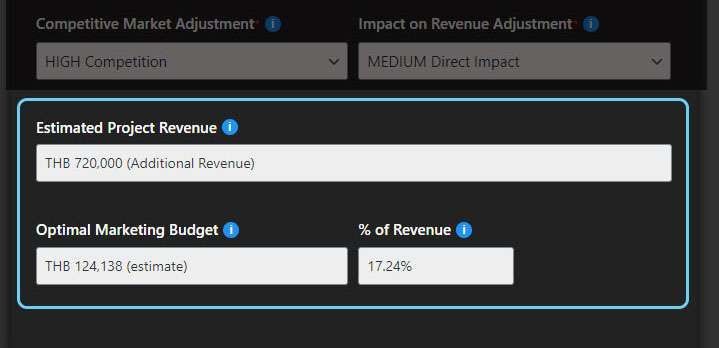
Estimated Project Revenue

Based on the details provided, this is the estimated Additional Project Revenue your project could generate.

Note: These calculations focus on projects that attract new customers to your business.  If your project targets existing customers, with goals to increase purchase frequency or average sale value you should use a manual calculation.


Optimal Marketing Budget

The optimal marketing budget is a recommendation for a suitable marketing investment for your project in order to meet your marketing goals and stay within your target marketing ROI.

The standard Buy Low & Sell High investment strategy doesn’t work when investing in marketing. Many marketing projects fall short because budget choices focused on maximum profit without factoring in if it could still deliver the critical business objectives.  Unlike stock options, when you invest in marketing your investment only pays off ‘if and when’ you achieve your marketing goals.

In Marketing, we are constantly learning what works for our business and what doesn’t. But this doesn’t work if your marketing efforts failed because of poor implementation. That’s why setting an appropriate budget is so important.


% of Revenue

This serves as a double-check.  It shows your investment amount as a percentage of your estimated project revenue.

Expect higher percentages if your investment is in long-term marketing processes. Startups often have higher initial investment costs than established businesses that already have a solid marketing foundation in place.