Stop Asking “How Much.” Start Asking “What Would You Do With This?”
The Question That Gets You a Better Marketing Quote Than “How Much?”
Different quotes usually mean different decisions
Ask three suppliers what a website costs, and the numbers that come back rarely seem to have much to do with each other. That confusion isn’t as mysterious as it feels. It’s actually easier to see clearly by starting somewhere that has nothing to do with marketing at all.
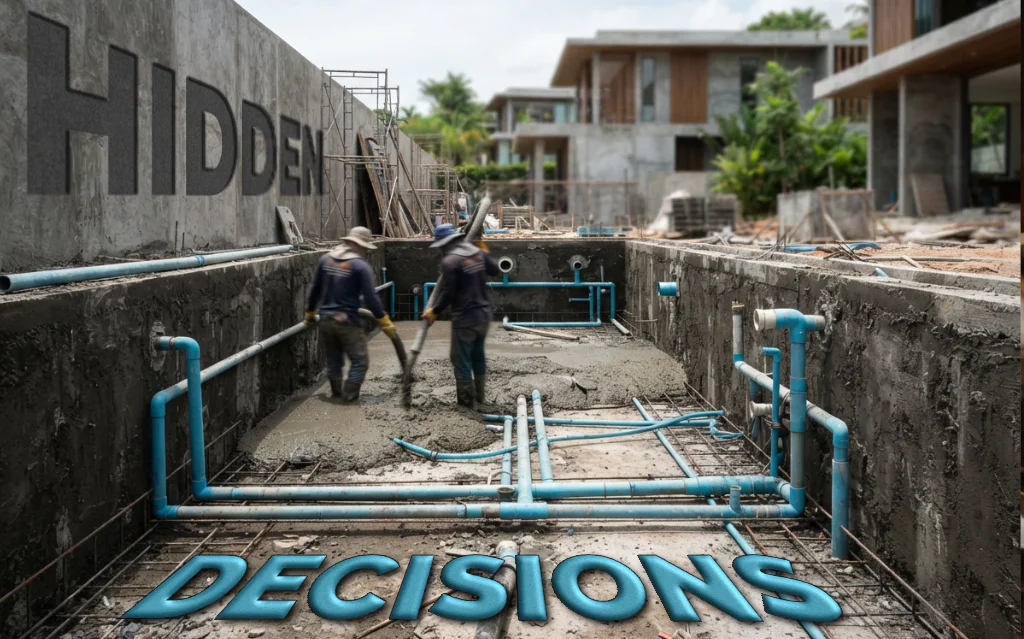
Ask two contractors in Thailand to quote the same pool build, and it’s common to get two very different numbers back. One encases the plumbing in concrete, since it’s faster and cheaper to install that way. The other deliberately leaves access to the same components, because experience has taught them these things eventually need attention.
Neither quote is wrong. They’re two different decisions about how to build the same pool.
The cheaper option feels like the smart choice, right up until something in that buried plumbing needs fixing. At that point, the saving turns into tearing up a finished pool to reach a pipe nobody ever planned on touching again.
You already understand this. You just don’t see it in marketing yet.
The pool logic makes sense the moment someone explains it. Of course you’d rather not smash up a finished pool one day to fix something that could have been made accessible from the start. But nobody would think to ask about it beforehand, unless they’d already been burned once, or happened to know to ask.
The exact same thing is sitting inside a website or marketing quote, just wearing different clothes. User intent, customer journey, conversion points, technical SEO, caching, how fast a server responds. This is the encased pipe. You’re not expected to understand any of it in depth. But it still changes what a project costs, and how well it actually performs once it’s built.
Price comparison hides the decision that created the price
Line up three quotes side by side, and it’s tempting to treat the middle number as the safe, sensible choice. That instinct works well in plenty of situations, because getting three quotes tells you something useful as long as all three suppliers are solving the same problem, in the same way.
The pool story already shows that isn’t guaranteed just because two quotes are technically for “the same thing.” In marketing, the specification is often something you genuinely can’t pin down alone, because the variables that matter most require specialist knowledge just to name, let alone weigh against each other. That’s not a flaw in how you’re shopping. It’s simply what buying expertise looks like from the outside.
Not knowing this isn’t a gap in judgement
Nobody expects a homeowner to know how a pool’s structural planning, construction or plumbing should be before they commission one. In the same way, nobody should expect you to understand caching, canonical URLs, or conversion architecture well enough to specify a website unaided. That was never your job.
What you are best placed to tell us is the context the work has to fit into, and that context changes the price far more than most people expect. A pool on an easily accessible plot costs less to build than one on a steep slope overlooking the ocean. The pool’s dimensions haven’t changed, but the engineering required to make it work on that slope has. The same is true of a website. Two businesses can need the same number of pages and the same features, and still face very different costs, because one has a straightforward setup and the other has years of legacy systems, a complex sales process, or a customer journey that has to work across three languages.
That’s why a website estimate has to start with what you need to achieve and the conditions it has to work in, not with a page count. That’s how we approach it. The number only means something once it’s clear what it has to hold up against.
There are two kinds of variables here, and they don’t belong to the same person
Some of the variables in a project belong to you: what the business actually needs, what success would genuinely be worth, what the current problem is costing, what level of investment makes commercial sense.
Some belong to the supplier: how to actually solve the problem, what work that involves, what technical and creative decisions are required, and what those decisions cost to execute properly.
The mistake was never asking for a quote. It was asking a supplier to price the half of the decision that was always yours to make.
That’s why “how much is a website” is an unhelpful question to open with. Not because it’s a bad thing to want to know eventually, but because there was never going to be one useful answer to it. The answer you get back will always be less helpful than you actually need.
What you already know, without knowing any of the rest
None of this requires a marketing background. How much is a new customer actually worth to your business? How many more do you actually need? What does your current sales process convert at? Where are your customers coming from right now? What is this project supposed to improve for your business? How important is that problem, honestly, compared to everything else competing for your attention? What happens if nothing changes at all? What would genuinely solving it be worth to you?
Only you can actually answer every one of those questions. No supplier, however good, can answer any of them from outside your business.
Asked outright, some of these can feel oddly uncomfortable to answer, even invasive. That’s a normal reaction, not a sign anything’s wrong. Nobody’s used to being asked what a customer is actually worth, out loud, in those terms.
It doesn’t change the fact that nobody else can answer it either.
Start with what it’s costing you, not what it might bring in
This is the hard part. The easy-sounding question “how much would doing X,Y or Z actually bring in?” is almost impossible to answer with any real confidence. Nobody knows, not really, until it’s built and running.
There’s a more answerable question sitting behind it. What is the current problem actually costing the business right now? Not what a fix might bring in, but what’s being lost by leaving it as it is.
If the answer is nothing, that’s useful information too. It means there’s nothing here worth spending on yet.
If the honest answer is “I don’t know,” that’s not a dead end. That’s exactly where the real work needs to happen, because nobody can put a sensible number on fixing something they’ve never actually measured or assessed.
The website, the campaign, the rebrand: none of it is ever actually the solution. It’s the instrument. The solution is whatever that instrument does for the business: the sale that doesn’t slip away, the enquiry that doesn’t go to a competitor instead. That’s where the actual value sits, and it’s easy to lose sight of the moment a business starts thinking in terms of “we need a website” instead of “we’re losing customers at this exact point, for this reason.”
Once you have that number, the rest is simple
Work out how long a fix that actually solves the problem would take to pay for itself. Then run the same sum again, assuming it only solves half the problem, and plan around that second, more cautious figure instead of the hopeful one.
Say a new booking system is expected to bring in two extra enquiries a month, each worth around 15,000 baht. At full success, that pays for a 100,000 baht project in a little over three months. At half that success, it takes closer to seven. Plan around the second number. It’s the one that still leaves the business in a reasonable position if reality falls short of the hope that justified the spend.
This isn’t pulling a number from thin air. It’s balancing expectation with risk.
Skipping this doesn’t remove the risk. It just changes who carries it.
None of this is easy to work out alone, and there’s no point pretending otherwise. It’s not that business owners don’t want to do this work. The effort needed is real: breaking down the customer journey, understanding what happens at each step, where decisions actually get made, and why they sometimes go your way and sometimes don’t. If that sounds like a full-time job, that’s because traditionally, it was one. If nobody in the business currently holds that role, it becomes one more hat to put on and figure out.
Here’s the good news. Nobody understands the business better than the person already running it. Your instincts and educated guesses about your own customers are very likely more accurate than an outsider’s would be, even without a formal customer journey map to point to.
But skipping it doesn’t make the risk disappear. It just moves the cost of getting it wrong from now, while it’s still cheap to fix, to later, when it isn’t.
The contractor who buried the pipes in concrete isn’t the one who pays when they eventually leak. He’s usually happy to come back and dig them out again, for a price. Sometimes he isn’t in business any more at all, and you’re left explaining the whole situation to somebody new, starting from nothing, paying twice for something that should only ever have cost once.
The cheapest option isn’t automatically the safest one
There’s an assumption behind a lot of budget decisions: that spending less is the same as risking less. If a project only costs a small amount, the thinking goes, the risk is small too.
That’s true in some situations, and completely false in others. The difference isn’t the amount of money. It’s how much the outcome actually matters.
Usain Bolt, by his own account, understood this better than most people ever will. At the 2008 Beijing Olympics, after one bad reaction to local food, he switched to eating almost nothing but McDonald’s chicken nuggets for ten days straight, “the only food I could properly trust which wouldn’t affect my stomach.” He wasn’t optimising for the theoretically ideal fuel for an Olympic sprinter. He was eliminating the one risk that could actually cost him everything: being too sick to compete. It worked. He broke three world records at those games. When he returned to Beijing for a major competition years later, with better food available, he skipped the nuggets entirely, which says everything about what they were actually protecting against.
The same logic applies to a marketing budget. The cheapest option only looks like the safest one if the stakes of it not working are genuinely low. The moment a project actually matters to the business, minimum investment stops being minimum risk, and starts being exactly the opposite: the choice most likely to leave the real problem unsolved.
A cheap failure usually teaches you nothing at all
Compared to the risk of getting a project wrong, minimum investment can feel like the obviously safer option. On the surface, that seems logical, right up until you think about what you’d actually learn from it.
Years ago, a boss of mine had a rule: there was no such thing as a mistake in marketing. Try something, have it fail, and the job was never at risk for that alone. It sounded like the easiest arrangement in the world, except for two conditions attached to it. Fail at the same thing twice, and that wasn’t acceptable. Fail at something and not know why it failed, and that wasn’t acceptable either. The whole thing only worked if a failure actually taught you something real, and you genuinely used what it taught you.
Apply that to something concrete. Imagine a TV campaign that could run at 3am, or the same campaign running at primetime. Choose the 3am slot because it’s cheaper, and the campaign doesn’t perform. What did that actually teach you? Not that TV advertising doesn’t work. Just that the target customers were asleep when it aired. Was the real problem the product, the price, the message, or the time slot? There’s no way to tell, because the one variable that mattered most, whether anyone was actually watching, was never actually isolated as a variable.
If the only reason the slot was chosen was the budget, there’s exactly one lesson available: minimum effort tends to produce minimum results. That’s not a market insight. It’s just arithmetic.
An unsuccessful budget isn’t a minimised investment. It’s a wasted one.
A budget isn’t really a balance between cost and risk. It’s a balance between cost, the return being aimed for, and the actual chance of achieving the outcome that was set out to begin with. Fund a project well enough to give it a genuine chance of succeeding, at a conservative estimate of return, and it’s in a far stronger position than the same idea starved down to the cheapest possible execution.
Unless a marketing activity actually succeeds at what it set out to do, the investment wasn’t minimised. It was wasted.
The original problem is still sitting there, still needing a solution, and there’s no way to tell whether the idea was wrong or whether it simply never had a real chance, underfunded the way it was.
That’s usually where the real damage begins. Convinced the idea itself must have been wrong, it’s tempting to try a different idea at the same low budget and see if that produces a different result. It usually doesn’t, for the same reason the first attempt didn’t. Eventually the pattern becomes impossible to ignore: the budget was the actual problem all along, not any of the ideas tested against it. By then, the original idea, implemented properly, is often still the right answer. It’s just been reached the expensive way, after several underfunded attempts have already been shown to the same customers, each one a little inconsistent with the last, each one quietly costing some of the credibility the business was trying to build in the first place. And that’s assuming there’s still budget left to actually do it properly.
Bring your number. Make the work the only variable.
With your budget figure in hand, a supplier conversation looks completely different. You’re not walking in trying to guess deliverables you were never equipped to specify, hoping the number that comes back happens to land somewhere reasonable. You’re bringing the one half of the decision that was genuinely yours to make.
There’s an instinct that resists this. It’s the same instinct that says never tell a car dealer your budget first, because they’ll simply charge you exactly that. It’s not a bad instinct in general. It just doesn’t apply here. A used car doesn’t change shape depending on what a buyer is willing to pay for it. The car stays the same; only the price moves. One variable: price.
A marketing project works on the same principle, just applied differently. It also comes down to one variable, but that variable is what you actually get, not what you pay.
You’ll still get different offers, and you’ll still need to judge whether a particular supplier can actually deliver. But the whole conversation shifts, from arguing about cost to genuinely tackling the business outcome you’re investing in.
Withholding your budget doesn’t protect you from overpaying, and it isn’t even a reliable way to get a better deal. It just leaves a supplier guessing, and turns the number itself into the main event, instead of the actual problem it was supposed to solve.
The solution doesn’t just get smaller. It changes shape.
There’s a common, unspoken assumption sitting underneath most marketing quotes: that there’s one right solution to a given problem, and budget simply decides how much of it a business gets. A bigger number buys the full version. A smaller one buys a scaled-down version of the same thing.
That’s rarely how it actually works. A solution built for a modest budget and a solution built for a generous one usually aren’t the same idea at two different sizes. They’re often genuinely different approaches to the same underlying problem. At one budget, the right answer might be a single, sharply written page with an easy way to enquire. At a larger one, it might be a fuller website built to support several customer journeys at once. At a smaller budget still, the best move might not involve a website at all. A properly optimised Google Business Profile and a handful of strong photographs can outperform a half-built site that was never going to be finished properly anyway.
That’s yet another reason to start from a defined budget rather than a smaller, cheaper version of a solution somebody else’s website happened to suggest. Walking into a conversation already convinced the answer is “a website” quietly decides the shape of the solution before anyone with the expertise to shape it has even heard your actual objective. The budget should help decide the shape. The shape shouldn’t get decided first and then squeezed to fit whatever’s left of the budget.
It’s part of why we’ve never built our own work around fixed packages, especially for something like a website. A price built around page count gives a proposal the feel of substance (a clear list, a clear number) while pulling attention away from the only question that actually determines whether the project works. A page count is easy to sell. It was never the thing doing the actual work.
The real question: “What would you do with this, and why?”
This is the question that actually replaces “how much.” It doesn’t force a supplier into a spec you were never qualified to write. It gives them room to bring real judgement to a real objective and a real number.
It also opens the door to the best possible answer a supplier can give: “Actually, I wouldn’t spend this on what you originally had in mind. I’d do this instead.” That’s not a difficult answer to hear, or a sign something’s gone wrong. It’s the clearest evidence a supplier is thinking about the actual problem, rather than simply filling an order at a price point.
One thing to keep in mind before asking it: a supplier’s answer tends to come filtered through whatever they specialise in. An SEO agency often finds an SEO problem. A web designer often finds a website problem. A social media specialist often finds a social problem. None of that makes any of them wrong, exactly. It’s simply where their particular expertise naturally looks first. Just keep an eye on how closely the diagnosis happens to match whatever that supplier sells.
This was never about who’s more expensive
It would be easy to take the wrong lesson from all of this. None of this is an argument that the pricier proposal is automatically the right one. It’s an explanation of why two genuinely competent suppliers can look at the same objective and the same budget and recommend different things, at different prices, without either of them being wrong.
The pool contractor who charged more wasn’t trying to take advantage of anyone. He’d simply already seen what the cheap version costs later, and priced accordingly.
It’s fair to ask why a supplier wouldn’t just hand over one detailed proposal covering every option and let a client pick. If they want the business, shouldn’t they be the one pitching for it?
In practice, that approach usually works against the client, not for them. Once someone’s seen what a fuller, more expensive solution looks like, a smaller, genuinely well-matched option can start to feel like a downgrade by comparison, even when it’s actually the right fit for that business. That’s the comparison playing tricks, not a real signal about which option is correct. The only number that actually settles which budget is right is the expected return for that specific business, and the odds of that landing neatly on one of two or three prices a supplier happened to pick in advance are genuinely slim.
Bringing what’s actually yours to bring
You were never meant to become a web developer, a designer, or a pool engineer before commissioning a website, a rebrand, or a marketing project. You were only ever meant to bring the one thing that genuinely belongs to you: a clear-eyed number, grounded in what the problem is actually worth to your business, and a real answer to what success should look like.
Bring that to the table, and the question changes from “how much” to something a supplier can actually answer well: what would you do with this, and why.

Founder of Hue Marketing | Brand Positioning & Customer Communication
I’ve spent more than 30 years helping businesses understand not just how to market themselves, but how customers interpret them. My work focuses on clarity, confidence and creating communication that works together rather than as a collection of individual assets. I work primarily with businesses where trust plays an important role in the buying decision.

Free Marketing Checklist
Marketing Essentials You Need To Know
Includes Self Assessment Checklist & Action Steps



Leave a Reply
Want to join the discussion?Feel free to contribute!